
GS1 Barcodes Explained: GS1-128, GTIN, and Supply Chain Identification
If you've ever wondered why every product in a modern supply chain seems to trace back to the same numbering system, this is why — and how to generate a compliant code yourself.
What GS1 actually is
GS1 is the global, non-profit standards organization behind the numbering systems that make modern retail and supply chains interoperable — the reason a barcode scanned at a checkout counter in one country can be traced back to the exact manufacturer and product line it came from, anywhere in the world. EAN-13, UPC-A, and GS1-128 are all GS1 standards, but they solve different layers of the identification problem.
GTIN: the number underneath the barcode
A GTIN (Global Trade Item Number) is the actual identifying number — the barcode itself is just a way to encode it for scanning. EAN-13 and UPC-A are two common physical encodings of a GTIN; the number underneath follows the same GS1 numbering logic regardless of which barcode format displays it.
A business gets its GTIN prefix by registering with GS1 (or a national GS1 member organization), which allocates a company prefix — the business then assigns product reference numbers within that prefix for each distinct product or variant.
What makes GS1-128 different from a standard product barcode
GS1-128 (sometimes still called UCC/EAN-128) isn't a barcode for a single product on a retail shelf — it's built on top of Code 128 to encode more than an identity number. Using "Application Identifiers" (short numeric prefixes inside the data), a single GS1-128 barcode can carry a product's GTIN alongside a batch or lot number, an expiration date, a quantity, a serial number, or a shipping container code — all in one scan.
This is why GS1-128 shows up on cases, pallets, and shipping cartons rather than individual retail items: it's built for supply-chain and logistics tracking, where knowing the batch and expiration matters as much as knowing the product identity.
Application Identifiers: the part that does the real work
Each piece of data inside a GS1-128 barcode is tagged with a 2-4 digit Application Identifier (AI) that tells scanning software what follows — AI 01 signals a GTIN, AI 17 signals an expiration date, AI 10 signals a batch/lot number, and so on. This structured tagging is what lets one barcode carry several distinct pieces of information that a receiving warehouse's system can parse automatically, rather than needing several separate barcodes.
SSCC: identifying a whole shipping unit
A related GS1 concept worth knowing is the SSCC (Serial Shipping Container Code) — a unique identifier for an entire logistics unit like a pallet or case, distinct from the GTIN of the individual products inside it. SSCCs are typically encoded in GS1-128 as well, letting a single scan confirm which specific shipment or container just arrived at a dock.
How Advance Ship Notices tie into GS1-128 data
In many supply chains, a shipment's GS1-128 barcodes work alongside an electronic Advance Ship Notice (ASN) — a message sent ahead of the physical shipment listing exactly what SSCCs, GTINs, and quantities to expect. When the shipment arrives, warehouse staff scan the GS1-128 barcodes on each case or pallet and the receiving system automatically cross-references them against the ASN, flagging any discrepancy (a missing case, an unexpected product) immediately rather than after a manual count. This scan-against-ASN workflow is one of the more concrete, high-value payoffs of adopting GS1-128 barcoding properly.
Common GS1-128 Application Identifiers worth knowing
A handful of AIs show up repeatedly in practice: 00 for an SSCC, 01 for a GTIN, 10 for a batch or lot number, 17 for an expiration date, 21 for a serial number, and 37 for a count of contained items. You don't need to memorize the full official AI table to work with GS1-128 day to day, but recognizing these common ones helps when reading or troubleshooting a real label.
GS1 DataMatrix: the 2D alternative
For situations needing GS1 data structure in a smaller footprint — pharmaceutical packaging is the most common example — GS1 DataMatrix packs the same Application Identifier structure into a compact 2D matrix code instead of a linear barcode, useful anywhere label space is limited but GS1-level detail is still required.
Do small businesses need GS1 registration?
If you're selling through any retailer, distributor, or major online marketplace, yes — you'll typically need a GS1 company prefix and GTINs for your products to be listed at all. If you're only shipping direct-to-consumer without going through traditional retail channels, GS1-compliant barcodes aren't strictly required, though GS1-128 style batch/lot tracking can still be genuinely useful for internal inventory accuracy.
How GS1 numbering scales from a single product to a global registry
GS1's structure is hierarchical by design: GS1 (the global organization) allocates country-level prefixes to national GS1 member organizations, which in turn allocate company prefixes to individual businesses, which then assign product reference numbers within their own prefix. This layered structure is what lets a single scan anywhere in the world resolve back to a specific product, from a specific company, registered through a specific country's GS1 office — without any central authority needing to individually approve every product number.
GS1 beyond barcodes: RFID and digital links
GS1 standards extend beyond printed barcodes — the same GTIN structure underpins GS1-compliant RFID tags (EPC, Electronic Product Code) used for higher-speed, non-line-of-sight scanning in advanced logistics operations, and GS1 Digital Link, an emerging standard for embedding the same product identification into a QR code or NFC tag that also opens a web page, blending traditional supply-chain identification with a consumer-facing digital experience in a single scan.
Common mistakes businesses make with GS1 barcodes
Reusing a GTIN across genuinely different products (different size, flavor, or packaging) is the most common and most disruptive mistake — it breaks the entire point of unique identification and causes downstream inventory and fulfillment errors that can be difficult to trace back to their source. A close second is failing to deactivate and properly retire a GTIN when a product is permanently discontinued, which can create confusion if that number is later reassigned without properly clearing historical records in retailer systems.
How GS1 prefixes are sized to company needs
GS1 doesn't issue a single fixed prefix length to every company — the length of your allocated prefix (and correspondingly, how many product numbers you can create within it) scales with how many distinct products you expect to register, from a handful for a small business to many thousands for a large manufacturer. This is worth checking when you first register, since choosing too small an allocation can mean returning to GS1 for an additional prefix sooner than expected as your product line grows.
GS1 in e-commerce marketplaces specifically
Major online marketplaces increasingly verify that a seller's GTIN actually traces back to a real, currently-registered GS1 prefix — part of an industry-wide effort to reduce counterfeit and duplicate listings. This is one of the more common places small sellers first encounter GS1 requirements directly, since a marketplace listing can be suspended or rejected if its barcode fails this verification, even if the barcode itself scans perfectly fine.
Frequently asked questions
Do I need a new GS1 prefix for every country I sell in? No — a single GS1 company prefix, once issued, is valid globally; you don't need separate registrations per country, only the one prefix from your home country's GS1 member organization.
What's the difference between a GTIN and a barcode?
A GTIN is the underlying number; a barcode (EAN-13, UPC-A, or GS1-128) is one of several physical encodings of that number into a scannable pattern. The same GTIN can, in principle, be represented in more than one barcode format depending on the context it's used in.
How much does GS1 registration cost?
Cost varies by country and by how many numbers you need, typically involving an initial registration fee plus an annual renewal — check with your national GS1 member organization for current pricing, since it's set independently in each country rather than globally standardized.
GS1 standards outside of physical products
GS1's identification system extends beyond physical goods — GLN (Global Location Number) identifies a specific physical location like a warehouse or store, and GSRN (Global Service Relation Number) identifies a service relationship, both usable within the same GS1-128 barcode framework alongside product identifiers. A distribution center's GS1-128 label, for instance, might combine an SSCC for the shipment, a GLN for the destination location, and a GTIN for the contents — three distinct GS1 identifier types working together within the same overall standard.
Getting help if you're new to GS1 compliance
National GS1 member organizations typically offer guidance resources, and many provide direct support for businesses navigating their first product registration — it's worth reaching out directly if your specific retailer or distributor requirements aren't clear from general documentation, rather than guessing at a barcode structure and risking a rejected listing later.
A quick summary before you register anything
GS1-128 for case, pallet, and logistics-level identification carrying batch, lot, or expiration data; EAN-13/UPC-A for individual retail units. Register your own GS1 prefix rather than reselling or reusing someone else's, and never reuse a GTIN across genuinely different products.
Keeping your GS1 registration details current
GS1 registrations typically require periodic renewal, and letting one lapse can create real problems if a retailer or marketplace re-verifies your prefix against GS1's database and finds it inactive — set a calendar reminder well ahead of your renewal date rather than discovering the lapse only when a listing gets flagged. Keep your registered company details (name, address, contact) current with GS1 as well, since a mismatch here can also trigger verification failures downstream.
Who actually enforces GS1 compliance
There's no single global enforcement body actively policing every barcode in circulation — compliance is generally enforced downstream, by the retailers, distributors, and marketplaces that refuse to onboard a product without a valid, verifiable GTIN. This market-driven enforcement, rather than top-down regulation, is part of why registering properly with GS1 matters practically even though no one is likely to audit an unregistered barcode directly.
GS1 and electronic data interchange (EDI)
GS1 identifiers don't just live on printed barcodes — the same GTINs, SSCCs, and GLNs are referenced throughout the electronic data interchange (EDI) messages that flow between trading partners, from purchase orders to invoices to advance ship notices. This is a large part of why GS1 standardization matters beyond the barcode itself: the printed code and the electronic paperwork describing a shipment both reference the same underlying identifiers, letting systems on both ends of a transaction reconcile physical scans against electronic records automatically.
How GS1 barcodes support product recalls at scale
When a large-scale product recall happens, GS1's structured identification is what makes it operationally possible to isolate exactly the affected batches across an entire distribution network — a recall notice referencing specific GTINs and lot numbers (carried in the GS1-128 barcode's Application Identifiers) lets every retailer and distributor in the chain query their own systems for that exact combination, rather than pulling an entire product line based on a name alone. This precision is one of the most concrete real-world payoffs of investing in proper GS1-128 labeling rather than treating it as a compliance checkbox.
Common misunderstandings about what GS1-128 actually requires
A frequent misconception is that GS1-128 is itself a barcode symbology distinct from Code 128 — it isn't; it's Code 128 with a specific structured data convention (the Application Identifier system) layered on top, meaning any Code 128-capable scanner can physically read a GS1-128 barcode, though the receiving software needs to understand the AI structure to correctly parse the multiple data fields packed inside it.
Getting started
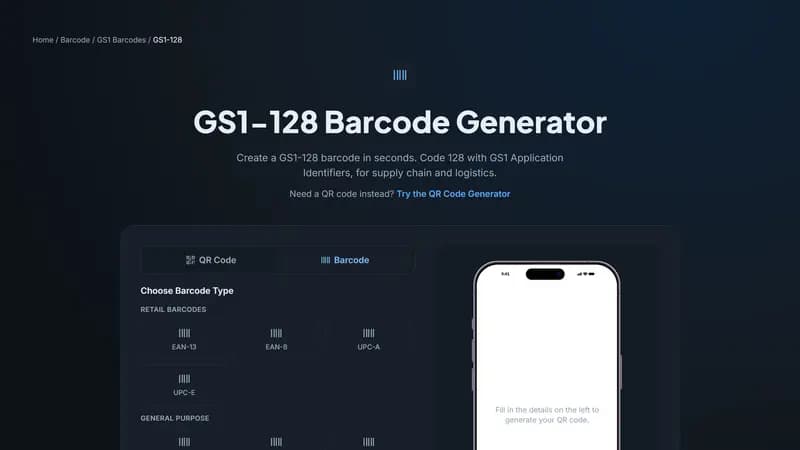
Generate a GS1-128 barcode above for case- or pallet-level logistics labeling, or an EAN-13/UPC-A for individual retail products — both free, with instant PNG, SVG, or PDF download.


Comments (0)
No comments yet — be the first.
Ready to make one of your own?
Free, no sign-up, and it works in your browser.
Try the GS1-128 Generator