
ITF-14 and Case Barcodes: A Guide to Shipping and Carton Labels
The barcode on a shipping case looks similar to the one on the product inside it — but it's encoding something meaningfully different.
Why cases need a different barcode than the product inside them
A single retail item carries its own EAN-13 or UPC-A barcode. But a shipping case containing, say, 24 units of that same item needs its own barcode too — one that identifies "a case of 24 of this product," not the individual unit. That's exactly the gap ITF-14 fills.
What ITF-14 actually encodes
ITF-14 (Interleaved 2 of 5, 14-digit) encodes a GTIN-14 — a 14-digit number built from the product's original GTIN (the same one on the individual item's EAN-13/UPC-A barcode) plus a leading "packaging indicator" digit that specifies the case configuration, such as how many units are inside. This means a case's ITF-14 barcode and the individual product's barcode are mathematically related, not unrelated numbers — scanning either one traces back to the same base product.
Why it uses Interleaved 2 of 5 instead of Code 128
ITF-14 is built on Interleaved 2 of 5, an older, simpler symbology than Code 128, chosen specifically because it produces a bold, high-contrast barcode that tolerates the rougher print quality of corrugated cardboard printing far better than more delicate formats — cases are usually printed directly onto (or as a label applied to) corrugated board, not smooth product packaging, and need a format robust to that environment.
Where you'll actually see ITF-14
Shipping cartons and cases at every stage of a supply chain, wholesale and distribution packaging, and warehouse pallet labeling alongside GS1-128 (which often appears on the same case, encoding additional data like lot number and expiration alongside the ITF-14 GTIN-14).
Bearer bars: the border you'll notice around ITF-14 codes
ITF-14 barcodes are typically printed with a thick bounding rectangle (a "bearer bar") around the whole code — this isn't decorative, it's a structural feature that helps the barcode maintain its printed dimensions and scan reliability on corrugated board, where ink tends to spread more than on smooth packaging.
Getting your case's GTIN-14 right
The 14-digit ITF-14 number is derived from your product's existing GS1 GTIN, not a separate registration — the packaging-indicator digit and check digit are calculated from the base product number and case configuration, so as long as you know your product's real GTIN and how many units are in the case, a compliant generator handles the rest.
How ITF-14 fits into a full case-and-pallet labeling system
A complete logistics label often carries more than just the ITF-14 code — it's common to see an ITF-14 barcode identifying the case's product and quantity alongside a separate GS1-128 barcode encoding a batch number, expiration date, or serial shipping container code (SSCC) for the specific pallet or shipment. Each barcode on the label does a distinct job: ITF-14 says what's in the case, GS1-128 (where present) adds the operational detail a warehouse or distributor needs beyond simple identification.
Common packaging-indicator mistakes
The packaging-indicator digit at the start of a GTIN-14 (which specifies the case configuration — how many of the base unit are inside) is a frequent source of errors when businesses calculate it manually rather than letting a generator derive it correctly from the base GTIN and case quantity. Getting this digit wrong doesn't just create an incorrect barcode — it can cause a receiving warehouse's system to log the wrong case quantity, creating inventory discrepancies that are often only caught during a later stock reconciliation.
Print placement and orientation on a carton
ITF-14 barcodes are typically printed on at least two adjacent sides of a shipping case, so a scanner can read the code regardless of which side happens to be facing outward on a pallet or conveyor — a detail worth confirming with your packaging supplier, since a single-side-only print misses this practical requirement common in most distribution center receiving processes.
How ITF-14 relates to case-quantity variations
The same base product might ship in multiple case configurations — a case of 12 and a case of 24, for instance — and each distinct configuration needs its own GTIN-14, since the packaging-indicator digit specifically encodes which configuration is which. Treating these as interchangeable, or reusing one case's barcode for a differently-sized case of the same product, causes the same kind of downstream inventory confusion as reusing a retail GTIN across genuinely different products.
Working with your packaging supplier
Most corrugated box manufacturers and label suppliers are familiar with ITF-14 requirements and can advise on print placement, bearer-bar sizing, and minimum print size for your specific box dimensions — it's worth sharing your generated barcode file with them early in a packaging redesign rather than after cartons are already ordered, since case dimensions and barcode placement need to work together for reliable warehouse scanning.
How distributors and retailers verify incoming cases
A distribution center receiving a shipment typically scans the ITF-14 on each incoming case against an Advance Ship Notice or purchase order, confirming both the product identity and expected case quantity before the shipment is accepted into inventory — a mismatch here (wrong product, wrong case size) triggers a hold rather than automatic acceptance, which is exactly the kind of costly delay a correctly generated, properly tested ITF-14 barcode prevents.
What happens when case configurations change over time
If a business changes its case-pack quantity — say, moving from 12 units per case to 24 — this requires a new ITF-14 barcode reflecting the new packaging-indicator digit, not a reused one from the old configuration, since retailers' and distributors' systems rely on that digit to know exactly how many units a scanned case actually contains. Coordinate this kind of packaging change with any trading partners in advance, since their systems may need the new case GTIN registered on their end before shipments in the new configuration will be accepted smoothly.
Why ITF-14 remains relevant despite newer 2D alternatives
Even as GS1 promotes broader 2D barcode adoption elsewhere in the supply chain, ITF-14 remains the standard for case-level marking specifically because Interleaved 2 of 5's bold, high-tolerance printing characteristics suit corrugated cardboard better than most 2D formats would at equivalent cost and printing simplicity. Replacing it would require re-equipping scanning infrastructure across an enormous number of warehouses and distribution centers globally — a cost that, unlike the more targeted retail point-of-sale transition sometimes discussed, doesn't currently have a strong enough efficiency case behind it to be underway at any real scale.
ITF-14 and pallet-level identification working together
A full pallet typically carries its own label too — usually a GS1-128 barcode encoding an SSCC that identifies that specific pallet as a unique shipping unit, distinct from the ITF-14 codes on the individual cases stacked on it. Scanning the pallet's SSCC on arrival lets a warehouse system instantly pull up everything that pallet should contain (cross-referenced against the shipment's Advance Ship Notice), while the individual case-level ITF-14 codes remain available for verification if cases are later broken out of the pallet and handled separately, such as during a partial pick for an individual store order.
Print resolution and material requirements for case labels
Because ITF-14 is built on Interleaved 2 of 5 specifically for tolerance to lower-quality printing on corrugated material, it doesn't require the same high print resolution that a dense format like Data Matrix would need — but it still has real minimum bar-width requirements, and printing too small relative to the case's intended handling distance remains the most common real-world cause of scan failures. Direct thermal or thermal transfer label printers (standard in most warehouse and packaging operations) reliably meet ITF-14's print quality needs; a standard office inkjet or laser printer is not typically used for this kind of high-volume industrial labeling.
A quick summary before you finalize case packaging
ITF-14 encodes your product's GTIN plus a packaging-indicator digit specifying case configuration, printed with a bearer bar on at least two adjacent case sides, sized for reliable scanning on corrugated material. Let a compliant generator derive the full number from your base GTIN and case quantity rather than calculating it by hand.
Keeping documentation for your case-labeling scheme
Maintain a simple record mapping each case configuration to its generated ITF-14 number, alongside your base product GTINs — this becomes invaluable if you ever need to regenerate a lost label file, onboard a new packaging supplier, or explain your labeling scheme to a new distribution partner's compliance team. A shared spreadsheet accessible to whoever manages packaging and logistics is usually sufficient for all but the largest operations, and it pays for itself the first time a packaging reorder needs to reference an old case configuration months after the original setup.
How ITF-14 requirements typically appear in a distributor's vendor guide
If you're a new supplier to a distributor or large retailer, their vendor compliance guide will typically specify exact requirements for case labeling — barcode placement, minimum size, required adjacent-side duplication, and sometimes even acceptable label stock and adhesive types. Reading this documentation carefully before your first shipment, rather than assuming general ITF-14 best practices are sufficient, avoids the compliance chargebacks or shipment rejections some large retailers apply for labeling that doesn't precisely meet their stated specification.
Planning ahead for packaging redesigns
Whenever a product's outer case packaging is redesigned — new box dimensions, new branding, a new case-pack quantity — treat ITF-14 barcode placement and sizing as a required part of that redesign process from the start, not an afterthought added just before printing. Looping in your packaging supplier and any major distribution partners early on a redesign avoids discovering a compliance mismatch only after new cartons have already been manufactured in bulk, which is a considerably more expensive problem to fix than adjusting a design file before production begins.
A checklist before your first ITF-14 print run
Confirm your product's real GS1 GTIN is correct and current, confirm the case quantity you're encoding matches what will actually ship in that carton, confirm placement on at least two adjacent sides of the box with your packaging supplier, and test-scan a printed sample from the actual production print run — not a proof or mockup — before committing to a full order of cartons.
Why case barcodes matter even for smaller manufacturers
It's tempting for a smaller manufacturer shipping modest volumes to skip proper case labeling, relying on manual counting and paper packing slips instead — but most distributors and retail warehouse partners require compliant case labeling as a condition of doing business at all, regardless of a supplier's size, since their receiving processes are built around scanning, not manual verification. Setting up correct ITF-14 labeling from the start, even at a small scale, avoids a disruptive scramble to retrofit compliant packaging once a larger distribution relationship is on the table.
Frequently asked questions
Do I calculate the ITF-14 number myself, or does a generator handle it? A generator should handle deriving the full GTIN-14 (including the packaging-indicator and check digits) from your base product GTIN and case configuration — you shouldn't need to calculate this by hand.
Why does my ITF-14 barcode have a thick border around it?
That's the bearer bar — a structural feature that helps the barcode maintain scan-reliable dimensions when printed on corrugated cardboard, where ink spreads more than on smooth packaging. It's a standard, expected part of a correctly formatted ITF-14 barcode, not a design flourish.
Can ITF-14 be used for anything other than shipping cases?
It's specifically designed and predominantly used for case- and carton-level packaging in a supply chain; for individual retail units, EAN-13 or UPC-A is the appropriate format instead.
Getting started
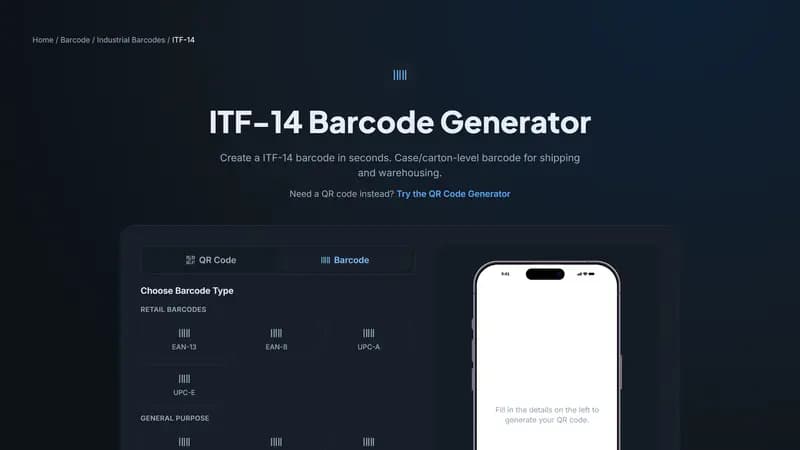
Enter your product's GTIN-based case number above to generate a print-ready ITF-14 barcode as PNG, SVG, or PDF — sized and formatted for direct application to shipping cartons.


Comments (0)
No comments yet — be the first.
Ready to make one of your own?
Free, no sign-up, and it works in your browser.
Try the ITF-14 Generator