
Barcodes for Healthcare: HIBC, Pharmacode, and Medication Safety
Medication errors are exactly the kind of mistake barcoding was built to prevent — here's how healthcare-specific barcode standards actually work.
Why healthcare needed its own barcode standards
Retail barcode standards (EAN-13, UPC-A) identify a product for checkout and inventory — that's not enough for healthcare, where identifying the exact device, lot, and expiration matters for patient safety and regulatory traceability. That gap is what HIBC and Pharmacode were built to close.
HIBC: identifying medical devices and supplies
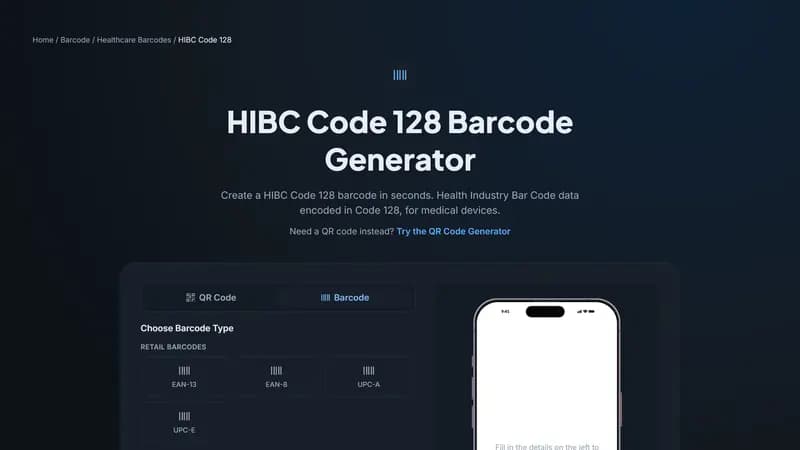
HIBC (Health Industry Bar Code) is a standard maintained specifically for healthcare products — medical devices, supplies, and pharmaceuticals — encoded using either Code 128 or Code 39 as the underlying barcode symbology, prefixed with a standardized data structure that identifies the labeler, product, and often a lot number or expiration date.
HIBC Code 128 and HIBC Code 39 aren't different from standard Code 128/39 in how the bars themselves are drawn — the difference is entirely in the structured data format encoded inside them, following HIBC's labeling conventions rather than a generic product ID.
Pharmacode: built for manufacturing verification, not identification
Pharmacode (and the two-track variant, Pharmacode 2) solves a completely different problem from every other barcode format on this page: it's not meant to identify a product to a human or a retail scanner at all. It's a simple, highly reliable code printed on pill blister packs and pharmaceutical packaging specifically so manufacturing-line sensors can verify, at high speed, that the correct packaging matches the correct medication during production.
Because its only job is fast, unambiguous verification on a production line, Pharmacode is deliberately simple compared to formats like Code 128 — it encodes a single number, not structured product data, and prioritizes decode reliability at speed over information density.
How these fit alongside GS1 healthcare standards
Increasingly, healthcare packaging carries GS1 DataMatrix codes (covered in our GS1 barcode guide) as well, particularly where regulatory serialization requirements demand tracking an individual unit's GTIN, lot number, and expiration together in a compact 2D format. HIBC and GS1 standards can appear on the same packaging serving different parts of the supply chain — HIBC for a historically established labeler-based system, GS1 where broader supply-chain interoperability is required.
The role of barcode standards in recall management
When a medical device or medication batch is recalled, the speed and accuracy of that recall depends entirely on how precisely the original packaging was labeled — a barcode encoding a specific lot or serial number lets a facility identify exactly which units on their shelves are affected, rather than needing to pull an entire product line out of an abundance of caution. This is one of the clearest, most concrete arguments for unit- and lot-level barcode serialization in healthcare, beyond the everyday convenience it also provides at the point of care.
Training staff on barcode-based safety checks
Barcode medication administration systems only improve safety if staff consistently scan every step rather than bypassing the process under time pressure — a barcode system is only as reliable as its actual usage rate, and hospitals that see the strongest safety improvements tend to be the ones with strict compliance around scanning every patient and every medication, every time, rather than treating it as optional for routine cases.
Why this matters for patient safety
Barcode medication administration (BCMA) systems — now standard in most hospitals — scan a patient's wristband and a medication's barcode before administration, cross-checking that the right drug, dose, and patient actually match before a nurse proceeds. This single practice has been credited with meaningfully reducing medication administration errors, and it only works because the underlying barcode standards (HIBC, GS1, or a facility's internal system) reliably encode exactly what's being verified.
Regulatory context: why serialization matters
Many countries now require some form of unit-level serialization for pharmaceuticals — a unique identifier on each individual pack, not just each product type — specifically to combat counterfeit medication and enable rapid recall tracing if a batch is found defective. This regulatory push (in the US, the Drug Supply Chain Security Act; in the EU, the Falsified Medicines Directive) is a major reason GS1 DataMatrix adoption has grown steadily in pharmaceutical packaging even where HIBC or Pharmacode were previously sufficient — unit-level serial numbers need the extra data capacity a 2D code provides.
How a hospital's barcode scanning workflow actually functions
In a typical barcode medication administration workflow, a nurse scans a patient's wristband first, then the medication's packaging, and the hospital's system cross-references both against the current medication order — flagging a mismatch (wrong patient, wrong drug, wrong dose, or wrong time) before the medication is administered rather than after. This entire safety check depends on the underlying barcode reliably and unambiguously identifying what it claims to, which is precisely the job HIBC, GS1, and Pharmacode standards were built to guarantee.
Why healthcare barcoding can't just use standard retail formats
A generic UPC or EAN barcode identifies a product type, but not the specific lot, expiration date, or serial number that matters for a recall or an expired-medication check — critical information in a clinical setting that a plain retail barcode was never designed to carry. This gap is exactly why healthcare-specific standards exist rather than the industry simply reusing retail barcode conventions.
The cost of getting healthcare barcoding wrong
A mislabeled or incorrectly encoded medical device or medication barcode isn't just an operational inconvenience the way a retail mistake might be — it can directly contribute to a patient safety incident if it causes a barcode medication administration system to fail to catch a genuine mismatch, or causes a recall to miss affected lots because the serialization data was wrong at the point of manufacture. This is a large part of why healthcare barcode standards are more rigorously specified and audited than general retail or logistics barcoding.
How manufacturers choose between HIBC and GS1 today
For new medical device products, many manufacturers now default to GS1 standards (including GS1 DataMatrix) given broader international regulatory alignment and marketplace compatibility, while HIBC remains common in existing product lines and specific segments of the industry that adopted it earlier. If you're starting a new product line, check your target market's specific regulatory requirements (FDA UDI in the US, EU MDR in Europe) before choosing, since the correct standard is often dictated by where the product will be sold rather than open preference.
Frequently asked questions
Is Pharmacode readable by a regular barcode scanner? Pharmacode is designed primarily for automated manufacturing-line sensors rather than handheld retail-style scanners, though compatible scanning equipment can read it — it's not intended for consumer-facing use.
Do all medical devices need HIBC labeling?
Requirements vary by country, device classification, and regulatory jurisdiction — check applicable regulations (such as FDA UDI requirements in the US) for your specific device category rather than assuming a single universal rule.
Can HIBC and GS1 barcodes appear on the same package?
Yes — it's common during transitions between standards, or where different parts of a supply chain expect different formats, for both to appear on the same healthcare packaging without conflict.
What a hospital pharmacy actually checks when receiving inventory
Beyond administration-point safety checks, hospital pharmacies typically scan incoming inventory against purchase orders and expiration-date thresholds, flagging any product nearing expiry for priority use or return before it becomes unusable stock. This receiving-side scanning is a second, distinct use of the same barcode standards covered in this guide — not just a safety check at the bedside, but an inventory-accuracy and waste-reduction tool earlier in the supply chain.
The broader trend toward end-to-end traceability
Healthcare barcode standards are increasingly part of a larger push toward full track-and-trace visibility — being able to answer, for any given unit of medication or device, exactly where it's been from manufacture through to the specific patient it was administered to. HIBC, GS1, and Pharmacode each play a role in different links of that chain, and understanding which standard governs which step is useful context even for a small clinic or pharmacy not directly managing large-scale supply chain systems.
Unique Device Identification and what it means for manufacturers
In the US, the FDA's Unique Device Identification (UDI) rule requires most medical devices to carry a standardized identifier — typically encoded as GS1 DataMatrix or, in some cases, HIBC — linking each device back to a public database entry describing the device type, and in many cases a production identifier covering lot, serial number, and expiration. This regulatory requirement is a major driver behind medical device manufacturers standardizing on one of the barcode systems covered here rather than using an ad hoc internal numbering scheme, since UDI compliance is a legal requirement for market access, not an optional best practice.
A quick summary before you label anything
HIBC Code 128 or Code 39 for historically-established medical device and supply labeling, Pharmacode for manufacturing-line pill and blister-pack verification, GS1 DataMatrix increasingly for unit-level serialization and regulatory compliance. Check your specific device classification and target market's regulations before choosing, since requirements are set by regulators, not left to open preference.
Staying current as regulations evolve
Healthcare barcode and serialization regulations continue to evolve as more countries adopt unit-level traceability requirements — if you're manufacturing or distributing medical products, periodically check your target markets' current regulatory guidance rather than assuming a labeling approach that was compliant several years ago remains sufficient today. Working with a regulatory affairs specialist or your industry association is often worthwhile when entering a new market with unfamiliar serialization rules, since the cost of getting this wrong (rejected shipments, compliance fines, delayed market entry) far exceeds the cost of proper upfront guidance.
How barcode scanning integrates with electronic health records
Scanning a medication or device barcode at the point of care typically logs that action directly into a patient's electronic health record automatically, timestamped and tied to the specific staff member who performed the scan — creating an audit trail that's become an expected part of modern clinical documentation, well beyond the immediate safety-check purpose the scan also serves. This integration is a major reason hospitals invest in barcode scanning infrastructure even beyond the direct medication-error-reduction case on its own.
International variation in healthcare barcode requirements
Healthcare barcode requirements aren't perfectly uniform worldwide — the EU's Falsified Medicines Directive, the US FDA's UDI and DSCSA requirements, and other countries' individual regulations each specify their own particular data elements and, in some cases, preferred barcode symbologies. A manufacturer selling into multiple regions often needs packaging that satisfies more than one regulatory scheme simultaneously, which is part of why GS1 DataMatrix's flexible Application Identifier structure — able to carry different combinations of required data per market — has seen broad international adoption as a practical common denominator.
Practical advice for a small clinic or pharmacy
If you're running a smaller healthcare operation rather than a hospital system, you likely won't need to generate HIBC or GS1-compliant barcodes yourself — those come pre-applied by device and medication manufacturers. What matters practically is having scanning equipment and software capable of reading whichever standard your suppliers use (increasingly GS1 DataMatrix), so your own inventory and administration-safety checks can actually make use of the data already printed on the products you're handling.
Evaluating scanning equipment for a healthcare setting
When choosing scanners for a clinical or pharmacy environment, confirm they support both 1D (HIBC Code 128/39) and 2D (GS1 DataMatrix) symbologies, since your supplier mix will likely include products labeled under both standards for years to come as the industry gradually shifts. Handheld imaging scanners generally handle this dual requirement more reliably than older laser-only scanners, which may only read linear barcodes and miss 2D-only labeled products entirely.
Getting started
If you're labeling medical devices or healthcare supplies to HIBC conventions, generate an HIBC Code 128 or Code 39 barcode above with your structured labeler and product data. For broader supply-chain or GTIN-based healthcare labeling, see our GS1 barcode guide instead.


Comments (0)
No comments yet — be the first.
Ready to make one of your own?
Free, no sign-up, and it works in your browser.
Try the HIBC Code 128 Generator