
Postal Barcodes: POSTNET, PLANET & Royal Mail Explained
Every letter that reaches your mailbox without a human reading the address by hand passed through a barcode along the way — here's what those actually encode.
Why mail needed its own barcode standards
Postal services sort billions of pieces of mail a year through automated equipment that reads a delivery address and routes each piece accordingly — far faster and more consistently than manual sorting ever could. Postal barcodes exist specifically to encode that routing information in a format high-speed sorting machinery can read reliably at scale.
POSTNET: the classic USPS format
POSTNET (Postal Numeric Encoding Technique) was the standard barcode printed on US mail for decades, encoding a ZIP code, ZIP+4, or full delivery point code as a series of tall and short vertical bars. It's been officially retired by USPS in favor of Intelligent Mail barcodes, but it remains relevant for historical mail-processing systems and is still occasionally required by older internal mailing software.
Intelligent Mail (OneCode): the current USPS standard
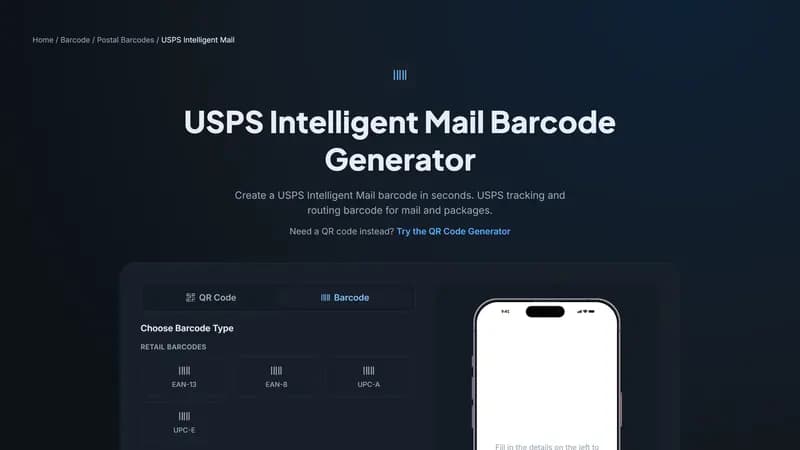
Intelligent Mail barcode (sometimes called OneCode) replaced POSTNET as the current USPS standard, encoding significantly more information in a single barcode — routing code, a mailer identifier, a serial number for tracking, and service-type information — all in one 4-state bar barcode (bars that vary not just in height but ascend, descend, or do both). This lets USPS both sort the mail and track individual pieces, which POSTNET alone couldn't do.
PLANET: tracking mail on its way back
PLANET (Postal Alpha Numeric Encoding Technique) was a companion format to POSTNET, historically used by USPS confirmation services to track a mailpiece's progress rather than encode its delivery address — think delivery and return-receipt confirmation rather than routing. Like POSTNET, it has been superseded by Intelligent Mail's built-in tracking capability, but remains relevant to legacy systems still processing older formats.
Royal Mail: the UK equivalent
Royal Mail barcode (also known as RM4SCC, the 4-state Customer Code) serves the same core purpose in the UK that Intelligent Mail serves in the US — encoding a postcode and delivery point so Royal Mail's automated sorting equipment can route mail without manual address reading. It uses a similar 4-state bar structure to Intelligent Mail, though the two are not interchangeable.
How postal barcode encoding was verified historically
Before software could reliably validate postal barcode data automatically, postal services relied on periodic manual audits and dedicated verification equipment to check that mailers' barcodes correctly matched valid, deliverable addresses — an important quality-control step, since an incorrectly encoded barcode routes a piece of mail to the wrong sorting path entirely rather than simply failing softly. Modern mailing software now performs this address validation automatically before generating a barcode, catching most errors well before a piece of mail ever enters the postal system.
Why some businesses still choose not to use postal barcodes
For low-volume mailings that don't qualify for or need presort discounts, adding a postal barcode manually provides little practical benefit, since the postal service applies its own routing barcode during processing regardless. These formats earn their keep specifically at bulk-mail volume, where the mailer's own barcode enables discount qualification and, in the case of Intelligent Mail, individual piece tracking that wouldn't otherwise be available.
Do you need these for normal business mailings?
For everyday letters and small mailings, no — the postal service applies its own routing barcode during processing regardless of what you print. These formats become relevant if you're running bulk mail operations, presorted mailings that qualify for postal discounts, or integrating with mailing software that needs to generate compliant barcodes as part of a bulk mail permit or automation workflow.
How automated sorting equipment actually uses these barcodes
High-speed mail sorting equipment reads a postal barcode and, within a fraction of a second, routes the physical piece of mail into the correct bin or conveyor path based purely on the encoded delivery point — no human touches the piece at all during this stage. This is only possible because postal barcode formats are deliberately simple and highly standardized, prioritizing scan speed and reliability at high volume over data richness, unlike a QR code, which trades some scan speed for far greater data capacity.
Barcoding for bulk mail discounts
Businesses running large mailing campaigns can often qualify for reduced postage rates by presorting mail and including a compliant postal barcode — since a correctly barcoded, presorted piece requires less manual sorting work from the postal service, some of that saved cost is passed back to the mailer as a rate discount. Mailing software that generates bulk mail typically handles the correct barcode format automatically as part of qualifying for these presort discount tiers.
International mail and format compatibility
Each country's postal service generally maintains its own barcode standard optimized for its own sorting infrastructure — Intelligent Mail for the US, Royal Mail's RM4SCC for the UK, and similar country-specific formats elsewhere. International mail typically relies on the origin postal service's barcode for outbound sorting, with the destination country's own systems handling final-mile delivery through their own separate processes rather than requiring a single universal international barcode standard.
The 4-state bar concept, explained simply
Both Intelligent Mail and Royal Mail barcodes use what's called a 4-state structure — instead of bars being simply present or absent like a traditional barcode, each bar can ascend above the baseline, descend below it, do both (a full bar), or do neither (a short tracker mark). This lets each bar carry more than one bit of information, which is how these formats pack routing, tracking, and service-type data into a relatively compact, fast-to-scan barcode compared to what a traditional two-state (bar or no bar) format could achieve in the same space.
Why postal barcodes need to be exceptionally damage-tolerant
Mail travels through a genuinely rough physical journey — sorting machinery, bins, trucks, and repeated handling — far more mechanically abrasive than a barcode on a shelf-stable retail product typically experiences. Postal barcode standards are designed with this in mind, favoring simple, robust bar patterns over data-dense but more fragile alternatives, prioritizing the barcode surviving intact all the way to final sorting over squeezing in more encoded information.
Frequently asked questions
Do I need to add a postal barcode to a normal letter myself? No — for everyday mail volume, the postal service applies its own routing barcode during processing; individual senders don't need to add one themselves.
Can incorrect postal barcode data cause a delivery failure?
If you're generating these barcodes as part of a bulk mail or presort operation, yes — an incorrectly encoded barcode can cause a piece to be missorted or rejected from an automated discount program, which is why mailing software that generates these codes typically validates the underlying address data first.
Are these formats used anywhere outside of postal mail?
Occasionally, for specialized high-speed sorting applications outside the postal system proper, but these formats were purpose-built for mail routing and aren't a common general-purpose choice outside that context.
What mailing software actually does behind the scenes
Modern bulk-mail software handles the entire postal barcode process invisibly to the sender — validating each address against the postal service's official address database, correcting minor formatting issues automatically, generating the compliant barcode, and often even simulating the presort process to confirm a mailing qualifies for the discount tier being targeted, all before a single piece is printed. Understanding what these barcodes actually encode is mainly useful for evaluating whether your mailing software is doing this correctly, or troubleshooting when a mailing gets flagged or rejected by the postal service.
A brief note on address hygiene
The reliability of any postal barcode depends entirely on the accuracy of the underlying address data feeding it — a barcode generated from an outdated or malformed address will route confidently and incorrectly, since the barcode itself has no way to know the address it's encoding is wrong. Regularly cleaning and standardizing a mailing list against current postal databases (a service most bulk mail software includes) matters at least as much as the barcode format itself for actually getting mail delivered correctly.
How postal barcode standards have evolved over the decades
The shift from POSTNET to Intelligent Mail, and the broader industry move toward 4-state barcodes generally, reflects a decades-long trend of postal services asking barcodes to do more — from simple routing in the early era, to routing plus tracking, to today's systems that also support delivery confirmation and sender-level analytics on mail performance. Each generation of postal barcode has generally packed more capability into a similarly compact, fast-to-scan format, mirroring the same density-versus-simplicity tradeoffs seen across every barcode standard covered in this series.
A quick summary before your next bulk mailing
Intelligent Mail (OneCode) for current USPS bulk mail and tracking, Royal Mail (RM4SCC) for UK mailings, POSTNET or PLANET only for legacy system compatibility. Clean, validated address data matters at least as much as the barcode format itself for reliable delivery and discount-tier qualification.
Choosing mailing software that handles this correctly
If you're selecting bulk mail software, confirm it handles current postal barcode standards and address validation automatically rather than requiring manual barcode generation — this is standard functionality in any reputable mailing platform, and its absence is a sign the software may not be well-suited for real bulk-mail compliance. Ask specifically about presort discount qualification support, since that feature varies more between platforms than basic barcode generation does, and request a sample output report before committing to a new mailing vendor.
Postal barcodes and privacy considerations
Because postal tracking barcodes can identify an individual mail piece down to sender and service level, mailers handling sensitive correspondence (financial statements, medical communications) should be aware that this tracking data is retained by the postal service for operational purposes — generally a reasonable tradeoff for reliable delivery confirmation, but worth understanding as part of a broader data-handling policy for organizations sending sensitive bulk mail.
How these barcodes interact with change-of-address processing
Postal services maintain ongoing change-of-address databases, and Intelligent Mail's tracking capability lets mailers receive electronic confirmation when a piece is forwarded or returned due to an outdated address — feedback that a static, unbarcoded mailing simply wouldn't provide. Larger-volume mailers use this data specifically to keep their own mailing lists current, closing a feedback loop between the postal system's routing data and the sender's own database maintenance.
Comparing presort tiers and their barcode requirements
Different presort discount tiers (carrier route, walk sequence, and others) have their own specific requirements for how mail must be sorted and barcoded before submission — a higher discount tier generally demands more precise sorting and barcode accuracy from the mailer in exchange for a lower postage rate, since the mailer is effectively doing more of the postal service's sorting work upfront. Mailing software typically presents these tiers clearly and calculates whether a given mailing qualifies, but understanding the underlying tradeoff helps when deciding whether the extra sorting effort is worth the resulting discount for a specific campaign, particularly for recurring mailings where the savings compound significantly over many cycles.
What to check if a mailing gets flagged for barcode issues
If a bulk mailing is rejected or delayed due to a barcode compliance issue, the most common causes are an invalid or unverifiable address feeding the encoding, a mismatch between the declared mail class and the barcode's encoded service-type data, or a printing issue (contrast, size, damage) affecting the physical barcode itself — checking these three areas in order usually identifies the problem faster than assuming a software or format failure.
Getting started
If your mailing software or bulk-mail workflow requires a specific postal barcode format, generate it above — Intelligent Mail (OneCode) and PLANET for USPS-oriented systems, Royal Mail for UK mailings, and POSTNET where legacy system compatibility is still required.


Comments (0)
No comments yet — be the first.
Ready to make one of your own?
Free, no sign-up, and it works in your browser.
Try the Intelligent Mail Generator